
Why Is My AC Running Constantly? 10 Common Causes And How To Fix It
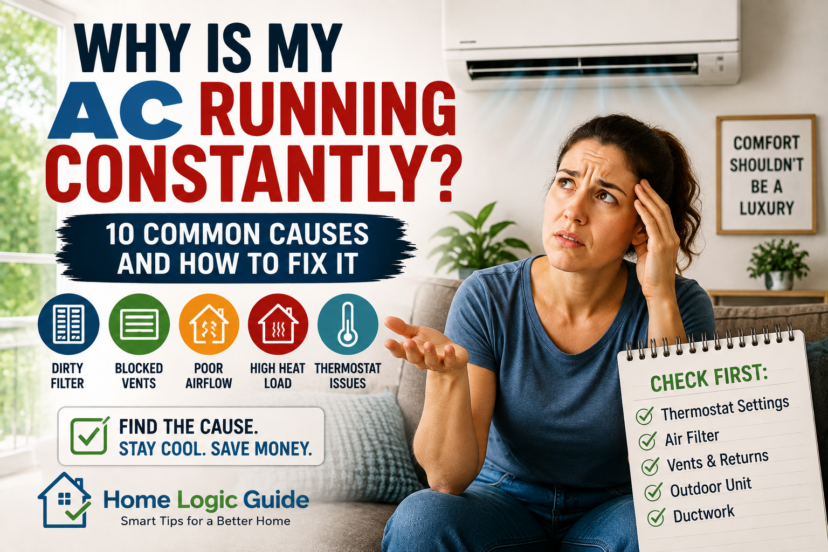
On a very hot summer afternoon, it’s normal for an air conditioner to run longer than usual. But when it seems like the system never shuts off, you may start wondering, why is my AC running constantly, and whether something is wrong.
Continuous operation doesn’t automatically mean your air conditioner is failing. Extreme outdoor temperatures, high humidity, direct sunlight, and a large cooling load can all create longer cycles. However, a dirty air filter, blocked airflow, thermostat problem, dirty coils, leaky ducts, poor insulation, refrigerant issues, or incorrectly sized equipment can also prevent your home from reaching the thermostat setting.
Ignoring a struggling AC may lead to higher electricity use, reduced comfort, and additional wear on components.
The best approach is to determine whether your system is simply responding to extreme weather or actually struggling to cool your home.
Here’s what to check first, which problems homeowners can address safely, and when it’s time to call an HVAC professional.
⚡ Quick Answer: Why Is My AC Running Constantly?
If you’re asking why is my AC running constantly, first check whether your home is reaching the thermostat setting. Long cycles can be normal during extreme heat, but nonstop operation may also result from a dirty filter, blocked vents, dirty coils, air leaks, duct problems, thermostat issues, refrigerant problems, or an undersized AC. If the house remains too warm despite continuous operation, the system should be investigated.
Key Takeaways
Most likely cause: The AC is struggling to reach the thermostat setting because of extreme heat, restricted airflow, excessive home heat gain, or reduced HVAC performance.
Usually serious? Not always. Long cycles may be normal during very hot weather, but continuous operation combined with poor cooling can indicate an HVAC or home-efficiency problem.
First thing to check: If you’re wondering why is my AC running constantly, check the thermostat setting, air filter, supply and return vents, and whether the house is actually reaching the desired temperature.
Best solution: Correct simple airflow and heat-gain problems first. If the AC still runs nonstop without maintaining temperature, schedule professional HVAC diagnosis.
🔍 Why This Happens – How To Identify The Problem
Air conditioners don’t normally operate according to a fixed schedule.
They respond to the cooling demand inside your house.
When indoor temperature rises above the thermostat setting, the cooling cycle begins. Once the desired temperature is reached, the compressor normally shuts off until additional cooling is required.
How long that takes depends on several factors, including:
- Outdoor temperature
- Indoor thermostat setting
- Humidity
- Home insulation
- Air leakage
- Window exposure
- HVAC condition
- System capacity
- Internal heat sources
During extreme summer weather, long cooling cycles can actually be more normal than rapid on-and-off cycling.
The important question is whether your home is staying comfortable.
If the AC runs for long periods but maintains the desired temperature, the system may simply be handling a large cooling load.
If it runs continuously while indoor temperatures keep rising, something may be wrong.
🛠️ 10 Common Reasons Your AC Runs Constantly
1. It’s Extremely Hot Outside
Before assuming there’s an equipment problem, look at the weather.
Your home’s cooling load increases substantially during periods of extreme heat.
Walls, roofs, windows, doors, and air leaks continuously transfer heat into the house. Strong afternoon sunlight can add even more.
During unusually hot conditions, your AC may need to run for extended periods to maintain the thermostat setting.
Pay attention to whether the problem disappears when outdoor temperatures become more moderate.
If it does, high cooling demand may be the primary explanation.
2. Your Thermostat Is Set Too Low
A thermostat setting that’s unrealistic for current outdoor conditions can cause the AC to run almost continuously.
Lowering the thermostat doesn’t make most central air conditioners produce colder air or cool the house faster.
It simply tells the system to continue operating until it reaches the new target.
If you’re setting the thermostat much lower than your normal comfort level because the house feels warm, you may actually make the AC run longer without addressing the underlying problem.
3. The Air Filter Is Dirty
A dirty filter can restrict airflow through your HVAC system.
As airflow decreases, the AC may struggle to move enough conditioned air throughout the house.
This can result in:
- Longer cooling cycles
- Weak airflow
- Uneven temperatures
- Reduced comfort
- Higher energy consumption
- Evaporator coil freezing in severe cases
Check the filter regularly and replace it according to the filter and equipment manufacturer’s recommendations.
Use the correct size and filter type for your HVAC system.
4. Supply Or Return Vents Are Blocked
Your HVAC system depends on unrestricted airflow.
Supply vents deliver conditioned air while return grilles bring indoor air back to the equipment.
Furniture, rugs, curtains, boxes, and other household objects can block these openings.
Walk through the house and check accessible registers and returns.
Make sure supply vents are open, and return grilles aren’t covered.
Avoid closing many vents to redirect cooling. Excessive vent closure can alter system pressure and potentially create additional airflow problems.
5. The Evaporator Or Condenser Coil Is Dirty
Your AC uses two major coils to transfer heat.
The indoor evaporator coil absorbs heat from household air, while the outdoor condenser coil releases that heat.
Dirt buildup can interfere with this process.
An outdoor condenser surrounded by vegetation, leaves, or debris may also struggle to release heat efficiently.
Keep the area around the outdoor equipment clear.
If the coils themselves require significant cleaning or access involves opening HVAC equipment, professional maintenance is usually the safer option.
6. Your House Has Air Leaks Or Poor Insulation
Sometimes a constantly running AC is doing its job—the house is simply gaining heat too quickly.
Common sources include:
- Poor attic insulation
- Leaky windows
- Gaps around doors
- Attic penetrations
- Unsealed exterior openings
- Large areas of unshaded glass
Rooms beneath poorly insulated attics or facing intense afternoon sunlight can create especially large cooling loads.
Improving air sealing, insulation, and window shading may reduce AC runtime while improving comfort.
7. Your Ductwork Is Leaking
Conditioned air needs to reach your living spaces.
If ducts leak in an attic, crawl space, garage, or other unconditioned location, part of the cooling you’re paying for may never reach your rooms.
Duct leakage can contribute to:
- Long cooling cycles
- Uneven temperatures
- Weak airflow
- Hot rooms
- High energy bills
Disconnected ducts can create even more significant problems.
Because much of the duct system is hidden, professional duct testing may be required to accurately identify leakage.
8. The AC Has A Refrigerant Problem
Refrigerant allows your air conditioner to transfer heat between the indoor and outdoor coils.
Improper refrigerant conditions, potentially resulting from a leak, can reduce cooling performance.
The system may continue running because it can’t remove enough heat to reach the thermostat setting.
Possible symptoms include poor cooling, icing, long cycles, and changes in system performance.
Refrigerant problems require professional diagnosis. Simply adding refrigerant without finding the reason it’s low isn’t a proper long-term repair.
9. The Air Conditioner Is Undersized
An AC that’s too small for the home’s cooling load may run nearly continuously during hot weather.
Proper sizing isn’t determined by square footage alone.
A professional cooling-load calculation considers factors such as:
- Local climate
- Insulation
- Air leakage
- Windows
- Building orientation
- Ceiling height
- Shading
- Occupancy
- Internal heat sources
If your AC has struggled to maintain comfortable temperatures since installation, sizing may be worth investigating.
10. Your HVAC System Is Aging Or Losing Performance
Air conditioners contain many mechanical and electrical components that can deteriorate over time.
A worn blower motor, failing fan component, dirty heat-transfer surfaces, compressor problem, or other equipment issue may reduce performance.
The system may compensate by running longer.
Age alone doesn’t prove an AC needs replacement.
A qualified technician can evaluate the system’s actual condition and determine whether repair, maintenance, or replacement makes the most sense.
🔎 How To Confirm The Cause
Start by comparing the thermostat setting with the actual indoor temperature.
If the thermostat is set to 74°F but the house remains at 80°F while the AC runs continuously, the system isn’t satisfying the cooling demand.
Next, inspect the filter and accessible vents.
Check airflow from several supply registers. Determine whether airflow feels weak everywhere or only in particular rooms.
Look at the outdoor condenser from a safe distance and make sure it isn’t surrounded by obvious debris or vegetation.
Then consider when the problem occurs.
Does the AC run continuously only during extremely hot afternoons?
Does it cycle normally after sunset?
Or does it run almost nonstop even during mild weather?
A system that struggles only during unusual heat may be dealing with a high cooling load. Continuous operation under moderate conditions deserves closer investigation.
🔧 How To Fix An AC That Runs Constantly
Start with simple corrections.
Replace a dirty filter, open blocked registers, clear furniture away from return vents, and verify that the thermostat is set appropriately.
Keep windows and exterior doors closed while the AC operates.
Use blinds, curtains, or shades to reduce intense solar heat through windows.
Keep obvious vegetation and loose debris away from the outdoor condenser.
If your house has significant air leakage or poor attic insulation, improving the building envelope may reduce the cooling load substantially.
When basic steps don’t solve the problem, professional HVAC evaluation is the next move.
A technician can measure:
- Airflow
- Static pressure
- Refrigerant operating conditions
- Coil performance
- Temperature differences
- Electrical operation
- Duct performance
- Equipment capacity
These measurements can identify the actual cause instead of relying on guesswork.
🚨 When To Call A Professional
Schedule HVAC service if your air conditioner runs continuously and can’t reach the thermostat setting.
You should also seek professional help if you notice:
- Warm air from vents
- Very weak airflow
- Ice on HVAC components
- Water around the indoor unit
- Unusual buzzing, grinding, or banging
- Frequent breaker trips
- Outdoor fan problems
- Sudden cooling-performance changes
- Dramatically higher electricity consumption
Electrical, refrigerant, compressor, and internal mechanical repairs should be left to appropriately qualified professionals.
🛡️ How To Prevent Your AC From Running Nonstop
Preventive maintenance can help your AC operate efficiently during peak summer weather.
Inspect the HVAC filter regularly and replace it when necessary.
Keep supply and return vents unobstructed.
Maintain clearance around the outdoor condenser and prevent vegetation from growing against it.
Reduce unnecessary heat gain by using appropriate window coverings during intense afternoon sunlight.
Maintaining attic insulation and sealing unwanted air leaks can also reduce the amount of heat your AC must remove.
Professional maintenance can identify dirty coils, drainage problems, worn electrical components, airflow issues, and other developing problems before they significantly affect cooling.
❓ Frequently Asked Questions
Is It Normal For My AC To Run All Day?
It can be normal during unusually hot weather, particularly if the system maintains the desired indoor temperature. Continuous operation becomes more concerning when the AC can’t keep the house comfortable.
Why Is My AC Running Constantly But Not Cooling?
Common causes include restricted airflow, dirty coils, duct leaks, refrigerant problems, excessive heat gain, or an HVAC system that isn’t providing enough cooling capacity.
Does A Dirty Filter Make The AC Run Longer?
Yes. A heavily dirty filter can restrict airflow, reducing system performance and potentially increasing cooling runtime.
Should I Turn My AC Off If It Keeps Running?
Not necessarily. Long cycles alone don’t mean the system is unsafe. However, shut the system down and seek professional help if you notice ice, burning odors, smoke, electrical problems, severe mechanical noises, or other signs of equipment failure.
Why Does My AC Run Constantly On 90-Degree Days?
High outdoor temperatures increase heat gain through the roof, walls, windows, doors, and air leakage. The AC may need longer cycles to offset that additional cooling load.
Will A Bigger AC Stop Constant Running?
Not necessarily. Oversized air conditioners can create their own comfort and humidity problems. Equipment should be sized using an appropriate cooling-load calculation rather than simply installing a larger unit.
Can Poor Insulation Make My AC Run Constantly?
Yes. Inadequate insulation and uncontrolled air leakage can allow heat to enter faster, increasing cooling demand and causing longer AC cycles.
🔗 Related Home Problems
A constantly running AC can overlap with several other common summer problems:
- Why is my AC not cooling enough?
- Why is my air conditioner freezing up?
- Why is one room so hot?
- Why does my house feel humid with the AC on?
- Why is my AC blowing warm air?
- Why does my air conditioner blow weak airflow?
- Why is my air conditioner so loud?
- Why is my energy bill so high?
Looking at these symptoms together can help reveal whether the underlying issue involves your HVAC equipment, ductwork, insulation, airflow, or the home’s overall cooling load.
🏠 Final Thoughts On Why Is My AC Running Constantly?
If you’re asking why is my AC running constantly, first determine whether your air conditioner is actually failing to cool your house.
During extreme summer heat, longer cooling cycles can be completely normal.
The bigger warning sign is an AC that runs continuously while the indoor temperature remains several degrees above the thermostat setting.
Start with simple checks.
Look at the thermostat, inspect the filter, open blocked vents, make sure return grilles aren’t obstructed, and check the outdoor condenser for obvious airflow restrictions.
Then think beyond the air conditioner.
Poor insulation, air leakage, duct problems, and strong solar heat gain can force perfectly functional HVAC equipment to work much harder.
If basic troubleshooting doesn’t solve the problem, professional measurements can determine whether you’re dealing with an airflow, refrigerant, equipment, ductwork, or home-efficiency issue.
Finding the actual cause—not simply lowering the thermostat—can help keep your home more comfortable, reduce unnecessary energy use, and protect your HVAC system from avoidable wear.
Disclaimer: This article is intended for general informational and educational purposes only. HVAC equipment contains high-voltage electrical components, moving parts, pressurized refrigerant, and other potential hazards. Do not open, dismantle, recharge, or repair HVAC equipment unless appropriately qualified. Consult a licensed HVAC professional for electrical, refrigerant, mechanical, or persistent cooling problems.


Comments are closed.