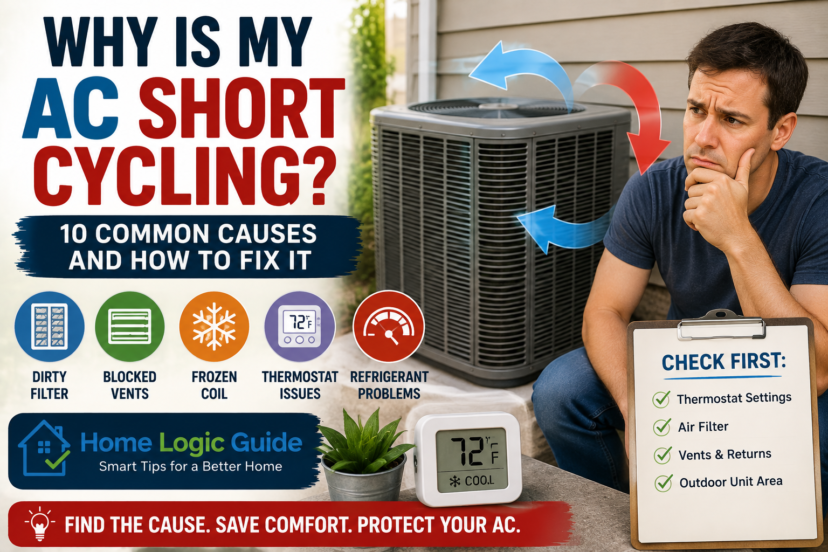
Why Is My AC Short Cycling? 10 Common Causes And How To Fix It
Your air conditioner should normally run long enough to cool and dehumidify your home before shutting off. If it repeatedly starts, runs briefly, stops, and then starts again, you may be wondering, why is my AC short cycling, and whether the system is heading toward an expensive repair.
Short cycling isn’t just annoying. Frequent starts and stops can reduce comfort, interfere with humidity control, increase wear on HVAC components, and potentially increase energy use. Sometimes the cause is surprisingly simple, such as a dirty filter, blocked airflow, or a thermostat problem. Other times, frozen coils, refrigerant issues, electrical problems, oversized equipment, or failing components may be responsible.
The important thing is to determine whether you’re seeing true short cycling or simply normal operation during changing indoor conditions.
Here’s how to recognize short cycling, what you can safely check yourself, and when it’s time to bring in an HVAC professional.
⚡ Quick Answer: Why Is My AC Short Cycling?
If you’re asking why is my AC short cycling, common causes include a dirty air filter, blocked airflow, thermostat problems, a frozen evaporator coil, dirty condenser equipment, refrigerant issues, electrical faults, or an oversized air conditioner. Start by checking the thermostat, filter, and vents. If the system continues switching on and off unusually quickly, professional diagnosis is recommended.
Key Takeaways
Most likely cause: Airflow restrictions, thermostat problems, coil issues, or another condition causing the cooling cycle to stop prematurely.
Usually serious? Sometimes. A dirty filter may be easy to correct, while electrical, refrigerant, or compressor-related problems require professional service.
First thing to check: If you’re wondering why is my AC short cycling, verify the thermostat settings, inspect the air filter, and make sure supply and return vents aren’t blocked.
Best solution: Correct simple airflow problems first. If short cycling continues, have the HVAC system professionally tested rather than repeatedly restarting it.
🔍 Why This Happens – How To Identify The Problem
Short cycling means the air conditioner repeatedly shuts down before completing what would normally be an effective cooling cycle.
There’s no single cycle length that’s correct for every house. Runtime varies with outdoor temperature, indoor temperature, humidity, equipment type, system capacity, and the home’s cooling load.
That’s why you shouldn’t diagnose short cycling simply because your AC turned on twice within an hour.
Instead, look for a pattern.
Possible signs include:
- AC starts and stops every few minutes
- Rooms don’t reach the thermostat setting
- Indoor humidity feels unusually high
- The outdoor unit repeatedly switches on and off
- Energy use seems higher than expected
- Cooling feels inconsistent
- The system makes frequent startup sounds
Frequent compressor starts are especially important because startup places additional demand on HVAC components.
If the behavior is new, identifying what changed can help narrow down the cause.
🛠️ 10 Common Reasons Your AC Is Short Cycling
1. The Air Filter Is Dirty
A dirty HVAC filter is one of the easiest things to investigate.
As dust, pet hair, and debris accumulate, airflow through the system can become restricted.
Insufficient airflow may contribute to abnormal operating conditions and, in severe cases, evaporator coil icing.
Check the filter after turning the system off.
If it’s visibly dirty, replace it with the correct size and type recommended for your HVAC equipment.
Then monitor the AC.
If short cycling continues, another problem is likely involved.
2. Supply Or Return Airflow Is Blocked
Your HVAC system depends on air circulating through both supply and return pathways.
Furniture, rugs, curtains, storage boxes, and other objects can block registers or return grilles.
Walk through the house and check accessible vents.
Make sure supply registers are open, and return grilles aren’t covered.
Avoid closing large numbers of supply vents in unused rooms. Central HVAC systems are generally designed around specific airflow requirements, and excessive restriction can interfere with normal performance.
3. The Thermostat Is In A Poor Location
Sometimes the HVAC equipment is fine, and the thermostat is receiving misleading information.
A thermostat exposed to direct sunlight or positioned near a heat-producing appliance may read a temperature that doesn’t accurately represent the rest of the house.
Other problematic locations can include areas near exterior doors or strong drafts.
If the thermostat heats up quickly and then cools down quickly, it may trigger unusual cycling patterns.
A professional can determine whether relocation or another thermostat solution is appropriate.
4. The Thermostat Is Malfunctioning
Thermostats contain sensors and electrical controls that can fail.
Loose connections, aging components, incorrect settings, or sensor problems may cause erratic HVAC operation.
If you have a battery-powered thermostat, replacing weak batteries is a simple troubleshooting step.
Confirm that the thermostat is set to COOL and isn’t following an unexpected programmed schedule.
If the thermostat display or HVAC behavior remains erratic, professional diagnosis may be necessary.
5. The Evaporator Coil Is Freezing
A frozen evaporator coil can interfere with airflow and normal AC operation.
Possible causes include airflow restrictions, dirty components, blower problems, or improper refrigerant conditions.
Signs include:
- Ice on refrigerant tubing
- Weak airflow
- Poor cooling
- Water around the indoor unit after thawing
- Unusual cycling
If you see ice, turn off the cooling system.
Don’t chip or scrape ice from HVAC components. Allow the system to thaw naturally and identify the underlying cause before returning to normal operation.
6. The Outdoor Condenser Is Dirty Or Obstructed
The condenser must release heat outdoors.
Leaves, grass clippings, vegetation, and other debris can interfere with airflow around the outdoor equipment.
Keep the area surrounding the condenser clear.
Don’t stack objects against it or allow shrubs to grow tightly around the cabinet.
A heavily dirty condenser coil may also affect system performance. Cleaning that requires equipment disassembly should generally be handled by an HVAC professional.
7. The System Has A Refrigerant Problem
Refrigerant conditions influence pressure and temperature throughout the cooling system.
An improper refrigerant charge, potentially resulting from a leak, can interfere with normal operation and may contribute to abnormal cycling.
You may also notice:
- Poor cooling
- Frozen coils
- Longer or irregular cycles
- Changes in HVAC performance
Refrigerant problems can’t be accurately diagnosed simply by looking at the equipment.
A qualified technician should measure system operating conditions, locate leaks when present, and make appropriate repairs.
8. The AC Is Oversized
A bigger air conditioner isn’t necessarily better.
An oversized AC may lower the temperature near the thermostat very quickly, causing the cooling cycle to end before the system has had enough time to provide balanced cooling and moisture removal.
The result can be frequent starts and stops, uneven temperatures, and poor humidity control.
Correct AC sizing requires a cooling-load calculation that considers factors such as insulation, windows, climate, air leakage, orientation, and home construction.
Don’t replace equipment with a smaller unit based solely on suspected short cycling. Have the system properly evaluated first.
9. An Electrical Component Is Failing
Air conditioners rely on several electrical components and controls to start, run, and stop correctly.
Problems with contactors, capacitors, wiring, control boards, sensors, or related components may contribute to erratic operation.
Warning signs can include:
- Buzzing
- Clicking
- Difficulty starting
- Breaker trips
- Intermittent operation
- Burning odors
Electrical HVAC repairs should be left to qualified professionals.
If you notice smoke, sparking, or a burning electrical smell, shut the system off if it’s safe to do so and seek prompt professional assistance.
10. The Compressor Or Another Major Component Has A Problem
Short cycling can sometimes indicate a more significant mechanical problem.
The compressor is responsible for circulating refrigerant through the cooling system and operates under substantial mechanical and electrical loads.
If it overheats or encounters certain operating problems, protective controls may shut the system down.
Don’t assume the compressor has failed just because the AC is short cycling.
Many less expensive problems can produce similar symptoms, so proper diagnostic testing is important before replacing major equipment.
🔎 How To Confirm The Cause
Start by observing the system.
Record approximately how long the AC runs before shutting off and how soon it restarts.
You don’t need to monitor it continuously for hours. A few cycles may reveal an obvious pattern.
Next, check the thermostat.
Make sure it’s set correctly and isn’t following an unexpected schedule.
Inspect the filter and replace it if necessary.
Walk through the house and make sure supply and return vents aren’t blocked.
Then check the outdoor condenser from a safe distance. Make sure vegetation and debris aren’t restricting airflow.
Look for additional symptoms such as:
- Ice
- Water
- Weak airflow
- Warm air
- Unusual noises
- Burning odors
- Breaker trips
These details can be extremely useful when describing the problem to an HVAC technician.
🔧 How To Fix An AC That Is Short Cycling
Start with homeowner-safe solutions.
Replace a dirty filter, remove airflow obstructions, open supply registers, and correct obvious thermostat settings.
If the thermostat uses batteries, replace weak batteries.
Keep vegetation and loose debris away from the outdoor condenser.
If you see ice, turn cooling off and let the system thaw naturally.
After correcting an obvious airflow issue, monitor the system.
If the short cycling disappears, the restriction may have been the cause.
However, don’t repeatedly reset breakers, restart equipment, or change thermostat settings trying to force a malfunctioning AC to operate.
Persistent short cycling should be professionally diagnosed.
A technician may evaluate:
- Airflow
- Static pressure
- Thermostat operation
- Coil condition
- Refrigerant operating conditions
- Electrical controls
- Compressor operation
- Equipment sizing
🚨 When To Call A Professional
Contact an HVAC professional if short cycling continues after checking the filter, thermostat, and accessible vents.
Professional service is particularly important if you notice:
- Ice on the AC
- Warm air from vents
- Very weak airflow
- Breaker trips
- Repeated buzzing or clicking
- Burning odors
- Water around HVAC equipment
- Poor cooling
- Outdoor unit repeatedly shutting down
Short cycling places additional starts on components, so persistent problems shouldn’t be ignored indefinitely.
Electrical, refrigerant, compressor, and internal mechanical repairs require appropriate training and equipment.
🛡️ How To Prevent AC Short Cycling
Regular HVAC maintenance can help reduce the risk of operating problems.
Inspect the air filter routinely and replace it when needed.
Keep supply and return vents unobstructed and avoid using furniture to cover registers.
Maintain adequate clearance around outdoor equipment and keep vegetation under control.
Professional maintenance can help identify dirty coils, electrical wear, drainage problems, airflow restrictions, and other developing issues.
When replacing an air conditioner, proper sizing is also important.
Avoid choosing equipment simply because it has more cooling capacity. A correctly sized system should be matched to the home’s actual cooling requirements.
❓ Frequently Asked Questions
How Do I Know If My AC Is Short Cycling?
Short cycling usually involves repeated, unusually brief cooling cycles followed by quick restarts. Because normal runtime varies, look for a persistent pattern combined with poor cooling, humidity problems, or frequent startup and shutdown sounds.
Can A Dirty Filter Cause AC Short Cycling?
A severely dirty filter can restrict airflow and contribute to abnormal HVAC operation, including coil icing. Checking the filter is one of the easiest first troubleshooting steps.
Is AC Short Cycling Dangerous?
Short cycling isn’t necessarily an immediate danger, but persistent rapid cycling can increase wear and may signal electrical, mechanical, airflow, or refrigerant problems that require attention.
Can A Thermostat Cause Short Cycling?
Yes. Incorrect thermostat readings, poor placement, faulty sensors, wiring issues, or incorrect settings can potentially cause abnormal cycling.
Can Low Refrigerant Make My AC Short Cycle?
Improper refrigerant conditions can interfere with normal AC operation and may contribute to cycling problems. Refrigerant issues require professional testing rather than DIY refilling.
Can An Oversized AC Cause Short Cycling?
Yes. An oversized system can cool the area around the thermostat quickly and shut down before providing balanced cooling and adequate moisture removal throughout the house.
Will Short Cycling Increase My Electricity Bill?
It can. Frequent startups and inefficient operation may increase energy consumption, although the actual effect depends on the cause, equipment, weather, and how frequently the system cycles.
🔗 Related Home Problems
AC short cycling can overlap with several other common cooling problems:
- Why is my AC running constantly?
- Why is my AC not cooling enough?
- Why is my air conditioner freezing up?
- Why does my house feel humid with the AC on?
- Why is one room so hot?
- Why is my AC blowing warm air?
- Why does my air conditioner blow weak airflow?
- Why is my air conditioner so loud?
- Why is my energy bill so high?
Looking at several symptoms together can help determine whether the underlying problem involves airflow, thermostat operation, ductwork, HVAC equipment, or your home’s cooling load.
🏠 Final Thoughts On Why Is My AC Short Cycling
If you’re wondering why is my AC short cycling, begin with the simple possibilities before assuming you need expensive repairs.
Check the thermostat.
Inspect the air filter.
Make sure supply and return vents aren’t blocked.
Look for ice, weak airflow, water, or unusual sounds.
If correcting a dirty filter or obvious airflow restriction restores normal operation, you may have solved the problem.
But persistent short cycling shouldn’t be ignored.
Electrical problems, refrigerant issues, frozen coils, oversized equipment, thermostat faults, and mechanical problems can all cause similar symptoms. Accurately identifying which one is responsible often requires measurements rather than guesswork.
The goal isn’t simply to make the AC stay on longer. It’s to restore normal operation so your system can cool and dehumidify your home efficiently without unnecessary starts and stops.
Addressing short cycling early can improve comfort, reduce unnecessary equipment wear, and potentially prevent a relatively small problem from turning into a larger HVAC repair.
Disclaimer: This article is intended for general informational and educational purposes only. HVAC equipment contains high-voltage electrical components, moving parts, pressurized refrigerant, and other potential hazards. Do not open, dismantle, recharge, or repair HVAC equipment unless appropriately qualified. Contact a licensed HVAC professional for electrical, refrigerant, compressor, or persistent cycling problems.